About the book
A field guide to the patterns that shape office life
You brief a colleague an hour before the client meeting. By the end of it the project has quietly become theirs. A manager praises the team in a way that removes your name from it. A favour arrives with an invoice nobody mentions.
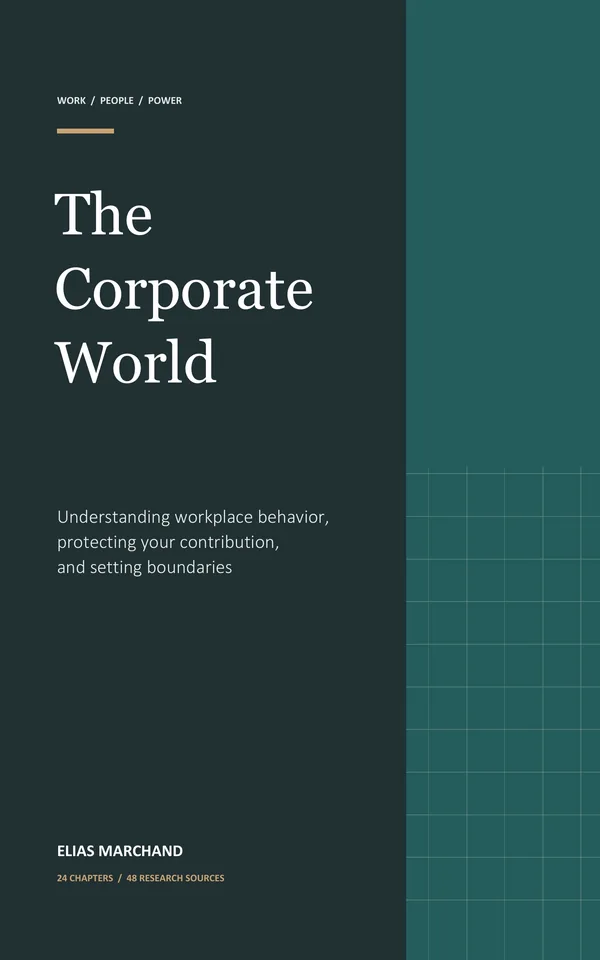
The Corporate World by Elias Marchand is a field guide to twenty-four patterns that shape office life – borrowed authority, performed busyness, exclusion from the meetings that matter, criticism that arrives as a verdict on your character – and to the responses that protect your contribution without making you the difficult one.
Each chapter pairs a situation you will recognise with what research in psychology and organizational behavior actually shows about it: what was measured, who was studied, and where the evidence stops. Forty-eight studies are cited, and their limits are stated plainly rather than dressed up as certainty.
This is not a book about retaliation or leverage. It is about making your work visible, correcting the record calmly, setting a boundary that holds, and telling an honest misunderstanding apart from a pattern that needs naming.
For anyone who does good work and has watched it travel under someone else's name.
Contents
What's inside
Three opening chapters on reading people and evidence, then twenty-four chapters in five parts.
Understanding the psychology
- Read the evidence carefully
- Separate behavior from motive
- Notice the cycle around the event
Contribution and credit
- The people behind the work
- Kindness with conditions
- Praise that hides ownership
- Performing busyness
- Briefings and selective stories
- Borrowed authority
- When protection creates obligation
- Make your contribution visible
Competition and control
- When a colleague envies you
- Exclusion from meetings
- Turning a mistake into a reputation
- Guarding territory
Recognition and feedback
- Recognition and special treatment
- When feedback feels personal
- Reviewing your own mistakes
Growth and expertise
- Taking the next career step
- Expertise with arrogance
- Diplomacy without surrender
Relationships and boundaries
- Build a wider network
- Discretion without secrecy games
- When a joke becomes a boundary
- Hear the conflict, check the facts
- When loyalty means extra work
- Work with clarity
Read a passage
From chapter 3
Praise that hides ownership
Credit-taking is not always a person announcing, “I did everything.” It can be a polished account of collective success: a difficult project, a determined team, and a few generous words for the people who helped. The speaker appears both capable and appreciative. Meanwhile, the people who designed the solution become supporting characters in the account of their own work.
There is nothing wrong with saying “we” or thanking colleagues. A genuine project leader may deserve substantial credit for coordination and decisions. The question is whether listeners leave with an accurate understanding of who contributed what.
You do not need to turn a celebration into a confrontation. You can respond: “Thank you. I developed the analysis, and my colleague tested the assumptions. The project lead coordinated the approvals. We were pleased to get it delivered.” This gives listeners a more complete account while recognizing legitimate contributions.
— The Corporate World, Elias Marchand
How it uses research
Evidence, with its limits stated
Every chapter separates three things: the situation, what a study can actually tell you about it, and the practical response that the book draws from it. The advice is presented as an application of the research, not as something the research proved.
Chapter 3, for example, uses Bolino, Long, and Turnley's review of impression management at work to explain how public praise can serve both a relationship and the speaker's reputation, and then notes what that review does not establish: that every appreciative manager is concealing weak performance.
Questions
About The Corporate World
- Who wrote The Corporate World?
- Elias Marchand. The book was published on 22 September 2026.
- What is The Corporate World by Elias Marchand about?
- Twenty-four patterns of office life, such as credit taken for your work, performed busyness, exclusion from the meetings that matter and loyalty that turns into extra work. Each chapter pairs the situation with the psychology and organizational behavior research behind it and with calm ways to respond.
- Where can I buy it?
- The Kindle edition is sold on Amazon (ASIN B0HKLPTND6). You can read it on a Kindle or in the free Kindle app on a phone, tablet or computer. Choose your Amazon store.
- Is it a book about office politics?
- It covers office politics, but it is not about retaliation or leverage. It is about making your work visible, correcting the record calmly and setting boundaries that hold.
- How long is it?
- Amazon lists a print length of 115 pages: three opening chapters, twenty-four chapters in five parts, and a list of 48 references.
Buy the book
Get The Corporate World on Amazon
Kindle edition. Pick the Amazon store for your country:
Also on Goodreads.